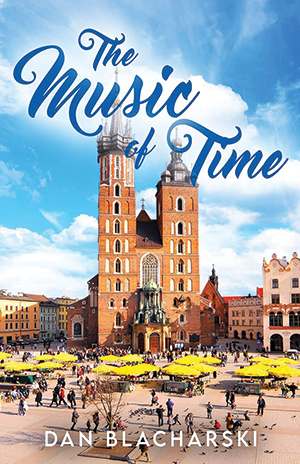
The Music of Time
by Dan Blacharski
Next Chapter Publishing, 2026
236 pages
reviewed by David Trawinski
This month’s review is of a unique novel of parasomnia adventure, quite unlike other time-travel novels I have reviewed. It is the first novel published by author Dan Blacharski, who has written in the worlds of business and fiction. His author’s profile describes his writing as exploring “the forces that shape institutions, power, and human decision-making … often drawing on the quiet intersections between personal lives and larger historical currents.” All this bears out in his debut novel, The Music of Time.
His protagonist, Roman, is a Midwesterner of Polish heritage from Indiana. Ever since the young age of five, he has experienced nightmares “of a bad place,” and even as a child, he knew these to be “dreams that were not dreams.” The novel’s title comes from the ethereal music he hears as these visions overtake him. He is transported to that other time, in fact, another life, again and again as he matures. In these transitional passages, it is revealed that he was often relaxing at a café in the beautifully medieval Rynek Główny of Kraków with the woman he knew to be his soulmate, the lovely and exquisite Eliana. Yet eventually, in these “dreams that were not dreams,” he always ended up with her in that “bad place,” which turns out to be Stutthof concentration camp.
Roman is driven by these experiences to travel to faraway Kraków, to sit in its sunny central square, looking out upon St. Mary’s church and the Sukiennice Cloth Hall, as he once long ago did with his beautiful Eliana. His guide in this quest turns out to be a young girl of eight years or so whom he first met inside his parasomnia. Her name is Elisabeta, and like Roman, she is a time traveler with whom Roman shares much. I don’t wish to give away too many elements of the story, because the author does an intoxicating job of revealing it in layers, not unlike Salome’s dance of the seven veils from Oscar Wilde’s play Salomé. The comparison to The Music of Time is fitting as Robert Strauss incorporated Wilde’s dance musically into his opera, “Salome.” My point is that both Wilde’s play and Strauss’ opera stretched the conventions of their genres for their time, and so does Blacharski’s novel.
Inside The Music of Time, there are plenty of things American Polonia will feel comfortable with: the usual Polish cultural and heritage references, the challenges of correct Polish language pronunciation, and even the excitement of traveling to the home country for the first time. Still, there are other concepts in this novel that could grate on the reader like the harsh mechanical grinding sound that Roman hears whenever he is pulled back to his modern-day reality: The clashing of Polish Catholicism with Midwestern Fundamentalist Protestantism, the slight out-of-phase uncertainty felt by Polish Americans when embraced by their ethnic Polish relatives, and the novel’s dealing with the subject of reincarnation, so foreign to many Poles’ belief structures based in Catholicism.
Still, if you ever felt like there are forces in your life that you don’t understand but you know must be real, this work is for you. If you have ever experienced what seems to be an extended or recurring feeling of deja vu, this novel is for you. If you ever felt that you and the love of your life have known each other in many prior lives, this story is definitely for you.
I am intentionally not giving away too much of the plot, but in its literary essence, it is a true love story. Nonetheless, the reader should prepare themself for detailed discussion of the Nazi’s inhumane cruelty to mankind in the concentration camps, including Stutthof.
Yet, it is artfully balanced against the beauty that everyday life can provide in its simple pleasures. As for the novel’s time-travel aspect, it reminded me of one of my favorite lines in cinema, from Francis Ford Coppola’s adaptation of Bram Stoker’s Dracula: “I have crossed oceans of time to find you.”